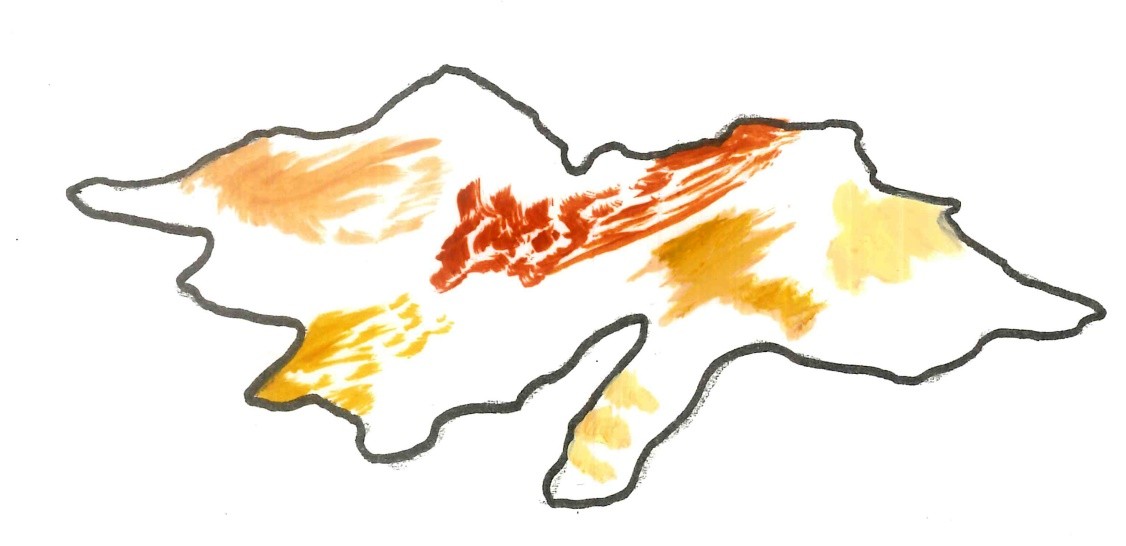
by Linda Pappagallo
In this photo and video story, pastoralists explain their practices of collective livestock-keeping in the drylands of southern Tunisia, focusing on a pooling practice called the khlata – which can be considered an example of commoning.
We are in the south of Tunisia – more precisely in the mountainous area called the Dahar, in the region of Tataouine. Rainfall is variable, often below 100 mm per year. Livestock remains an important livelihood option for many people in such dryland regions.
Several communities are found along the crest of the Dahar plateau, including Douiret, Chenini, Ghomrassen and Toujane, where historically human mobility and migration have been a defining sociological feature of these rural economies.
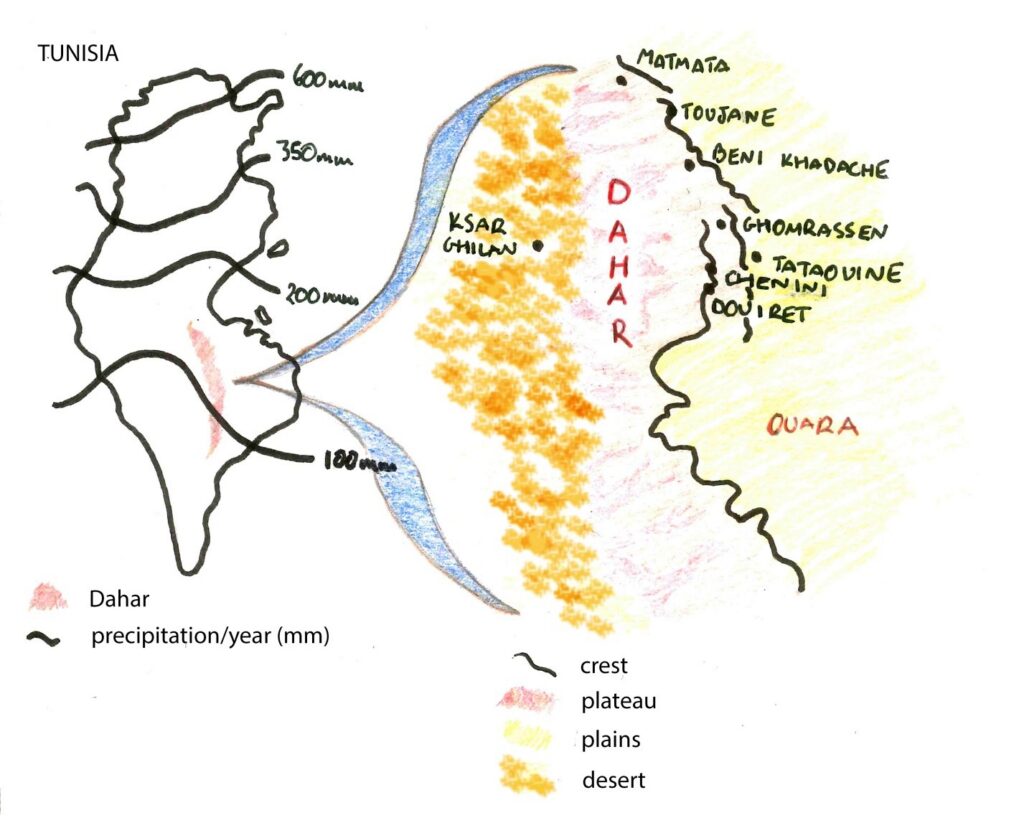
Today the political-economic and environmental conditions are clear: inflationary trends, an erosion of food sovereignty with growth-oriented production models, insecure access to water, variable costs of production, and changing values. For context, the testimonies in this piece were recorded in 2021-2022 (1 dinar = 0.30 euro).
Today, other compounded dynamics further influence the nature of uncertainty. These livestock owners share with us the implications of these conditions in 2021-2022:
Cultural values:
Insecure access to water/pasture, and variable costs of production:
Erosion of food sovereignty with growth-oriented production models:
Inflationary trends:
Access to land
Now, imagine a community where access to land depends on your tribal affiliation, your arch. There are no fences, just a tacit understanding that boundaries are negotiated; they are porous.
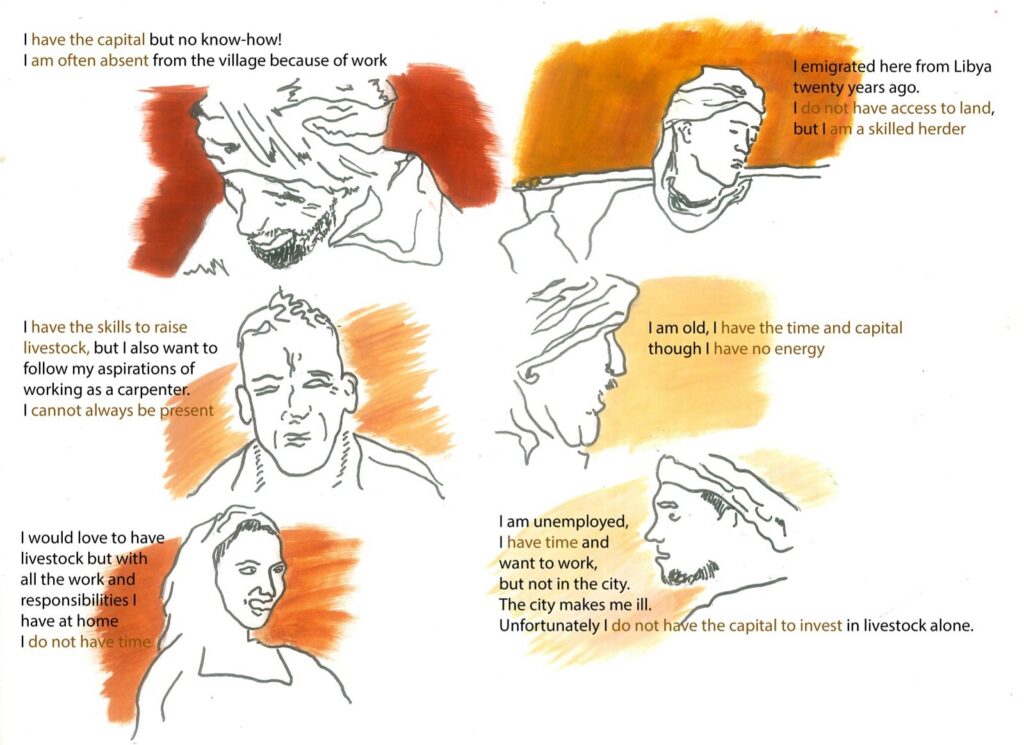
In this community you have a diversity of individuals with different wants, needs, fears, possibilities, privileges and endowments, each with the desire to keep livestock.
In many parts of Tunisia, especially in the south, each individual is part of a clan (arch). Each arch has access-rights to different land, and different areas of pasture.
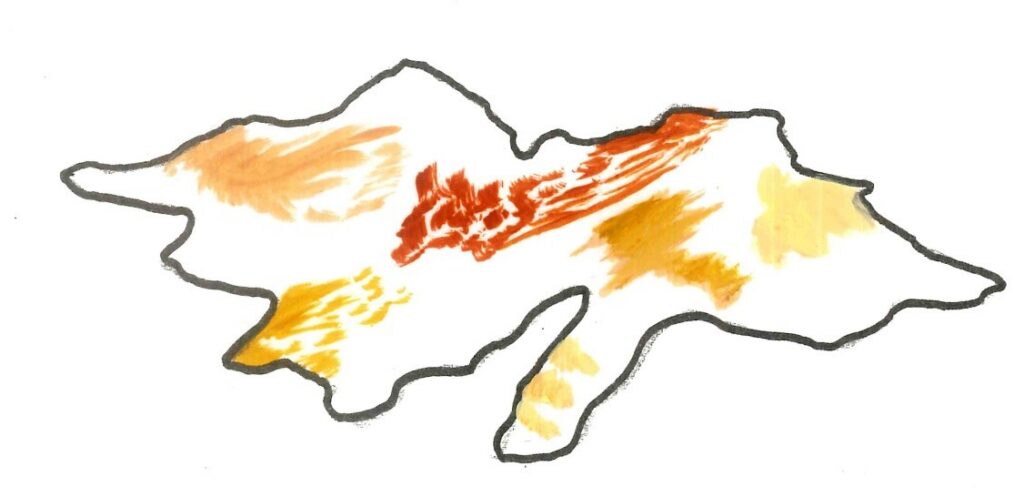
The diversity of individuals with different wants, needs, fears, possibilities, privileges and endowments also includes different access rights in a heterogeneous landscape.
As we will explain, it is thanks to this diversity that there exists one of many solutions to managing livestock in environmentally challenging contexts.

The khlata
The khlata [ (n.) (v.), from Arabic to mix], is the act of mixing, pooling resources. In the south of Tunisia, the term assesri (in Amazigh) is also used. The khlata describes collective herds, where different individuals decide to pool livestock together.
Through the khlata, as individuals pool their livestock, they also indirectly pool their different wants, needs, fears, possibilities, privileges, endowments and ‘resources’, including access rights to different types of pasture.
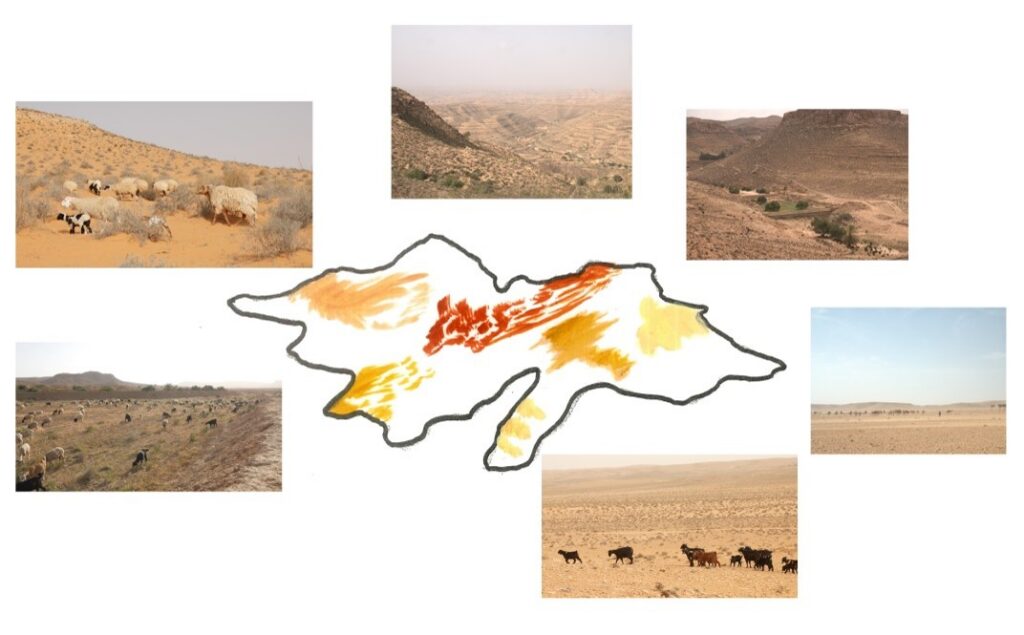

The collective herd can access a wider variety/range of pasture than the individual herd.

If managed well, the khlata as an option is another means to organize his growing capital throughout his life.
So the khlata allows livestock-keepers to maintain a fluid ‘presence’ towards the herd and within the community!
In fact the khlata is versatile, and it simply represents an alternative solution where people organize themselves to manage livestock in a collective manner.
This livestock-owner explains to us some of the basic mechanics of how the khlata is organized:
The khlata through time
Through time, the khlata has of course evolved:
and there are several views on the utility and use of the khlata today…
Note: in the above video the livestock owner uses the term khammes to describe “a worker from outside”. The original meaning and term khammes describes a labour-relation where the labourer is given one fifth of the harvest/yield as compensation for his annual work. This term is however used in different ways to describe different labouring relations. Depending on how it is used it has different cultural/stereotypical connotations.
… including, for example, the view that the khlata is not an efficient way of keeping large numbers of livestock …
… and the fact that there are different ways the khlata can be organized …
What is clear is that the use of the khlata depends on the individual objectives and the context. For example, the khlata is more important in the south than in the north, because:
“in the north there is more rain and vegetation, the office of cereals is accessible, and the availability of rangelands means that the expenses are less significant, than in the south”
As Jalloul suggests, the khlata is most commonly used in the southern regions because the variability in access and availability to ‘scarce resources’ incentivizes collective and reciprocal arrangements, rather than individualized models of farming.
To do this, however, you need:
TRUST:
RESOURCES:
COOPERATIVE CULTURE:
Note: “Inshallah, Rabbi maekom w n’shalla matar” (“God be with you and we pray for the rains”) Only a Farmer can understand another farmers struggle. Who is going to understand my struggle? The Government? No
And COMMUNICATION:
Khlata as commoning
One could say that the khlata model goes beyond profit. It is an alternative solution to a growth and profit-oriented market, and it can provide a ‘safety net’ for a wider diversity of individuals, especially in times of need and scarcity. The khlata could be considered as an example of a commoning practice.
Like other examples of commoning practices in Tunisia show, the khlata can nurture:
Social integration
Social solidarity
Social transformation
Moral economy/environmental stewardship
Autonomy
Situated knowing
Heterarchy
Peer governance
Relational property
Citizenship
Further reading
Agriculture et émigration dans les stratégies productives des jbalia du Sud-Est tunisien, Noureddine Nasr
Les effets des réseaux transnationaux sur l’économie locale et régionale à Tataouine (Sud-Est tunisien), Hassen Boubakri
Les nouveaux visages du pastoralisme ‘moderne’ du grand sud tunisien, Saad, A. B., & Bourbouze, A.
Partir Pour Rester, Linda Pappagallo (photo story)
“Partir pour Rester?” To leave in order to stay? The role of absence and institutions in accumulation by pastoralists in Southern Tunisia, Linda Pappagallo (doctoral thesis)
Acknowledgements
I would like to thank all of the participants of Douiret and beyond who have collaborated in this endeavour. In particular I would like to thank Nabila Talbi, Hamdi Dallali, Hedi el-Jeni, Oussema Gaidi and Hiba Saidi.